Este artículo todavía no está traducido, así que lo verás en inglés.
The Gift Is That You Were Paying Attention
31 de agosto de 2026 · 7 min de lectura
Most gifts answer a question: what does this person need, or want, or already almost have. You stand in an aisle in August, ceiling fan turning, and you try to guess.
A made book answers a different question. Not what do they want, but what have I noticed about them. That's a harder question and a kinder one, and the answer is already sitting in your head, unlabeled, waiting.
The gift isn't the object, it's the attention behind it
Think about the gifts you've kept. Not the good ones, the kept ones. There's usually something slightly off about them: a mug in a color no one else would have picked for you, a photo someone took when you didn't know, a note on the back of a receipt. What made them stick wasn't quality. It was accuracy. Somebody was paying attention when you weren't performing.
That's the whole thing. A made book is a way of handing someone your attention in a form they can hold. The illustrations are lovely and the cover feels good in the hand, but the part that lands is the specific detail nobody else would have thought to include: the way she says "actually" before every sentence, the fact that he won't walk past a storm drain without looking in.
You don't have to be a writer for this. You have to have been in the room. That's the only qualification, and if you're reading this about someone you love, you already meet it.
Noticing is a skill you already have, just not on purpose
Here's the strange part about attention: you've been collecting for years without filing anything. You know exactly how your kid holds a popsicle, wrist turned out, chin forward, whole body braced against the drip. You know your dad's voice changes when he talks to the dog. None of it feels like material because it's just Tuesday.
So the work of making a book is mostly retrieval, not invention. Sit somewhere quiet for ten minutes and let yourself get boring. Don't reach for the big memories, the birth story or the trip to the coast. Reach for the small repeated ones, the things that happen so often you stopped seeing them.
It helps to think in senses instead of events. What does this person sound like from the next room. What do they smell like in summer, sunscreen and cut grass and the inside of a car. What do their hands do when they're thinking. That's where the noticing lives, and it's more useful than any plot.
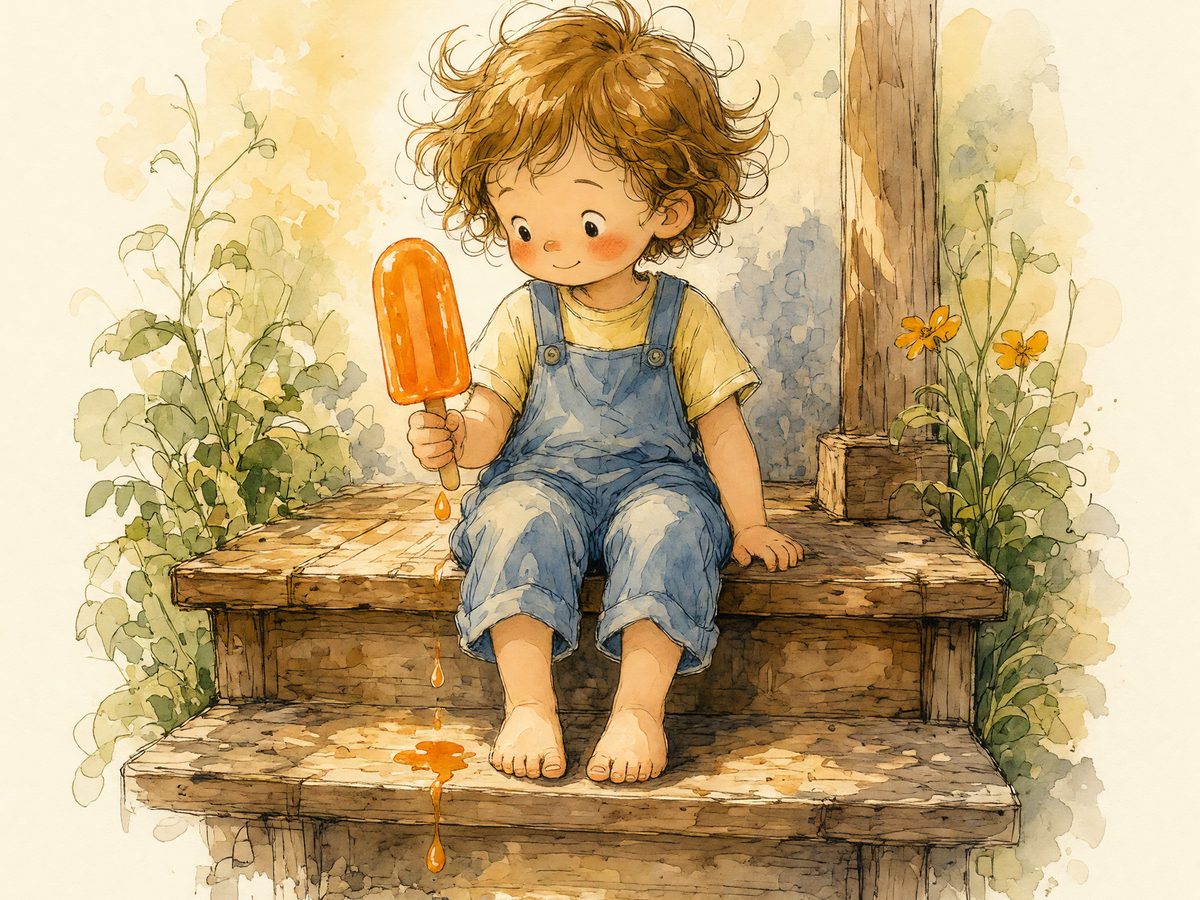
Small things that are worth more than they look
When people sit down to make a book, they often start by apologizing. Nothing interesting has happened. We're just a normal family. Then they start talking and it turns out there's a running joke about a specific traffic cone, and a grandmother who narrates everything she cooks, and a cat who only sits on people who are sad.
If you're not sure where to look, look here:
- The phrase they say that nobody else in the family says, and the way it started.
- Where they sit. Not their assigned seat, the one they actually choose.
- The thing they're weirdly brave about, and the thing they're weirdly not.
- What they do first when they walk in the door in August: shoes off, fridge open, fan on.
- The food they eat in a specific order, and the order.
- A place that's theirs, a curve of sidewalk, a step, a branch, the back seat behind the driver.
- The sound of them being happy, which is usually not laughing but something quieter.
Any one of those is enough to build a short story around. You don't need seven. Pick the one that made you smile as you read it, and start there. If you want to see what that looks like once it's illustrated and bound, flip through a sample and notice how much of the warmth comes from the tiny specific bits.
August is a good month for this, quietly
Late summer has a particular quality of attention built into it. Things are ending. The light comes in lower in the evenings. Somebody in the house is counting down to a first day, and you can feel the year turning over even while it's still too hot to think.
That's a noticing month. You're already half-aware that this exact version of your kid, this height, these obsessions, this way of pronouncing certain words, is temporary. The bare feet on hot pavement, the screen door, the shorts that fit in June and won't in October. You don't have to make it sad. You just have to write some of it down before it gets swapped out for the next version.
And practically speaking, August is far enough ahead of the gift-giving season that you're making something because you want to, not because a date is chasing you. A book made in a slow week feels different from a book made in a hurry. There's more room in it.
You can't keep the summer. You can keep what you noticed about it.
Two ways to hand over your attention
Some people want to do all of it themselves. If that's you, the hands-on creator path lets you build the characters, shape each story, and edit every page until the words sound like your words. It takes longer, and for a lot of people the making is the point. You get to sit with the memories a while.
Other people know exactly what they want to keep and would rather not wrestle with sentences. In that case you tell us who it's for and one moment worth keeping, and we write and illustrate the whole thing. That's not a lesser version. The noticing already happened when you chose the moment. Everything after is craft, and the steps are simple either way.
Both paths start the same way: you approve the character art before anything else, so the face in the book is a face you recognize. And both end the same way, with a keepsake of short illustrated stories, yours to keep digitally, with a hardcover if you want something that sits on a shelf and gets carried around and eventually gets a bent corner.
What it feels like on the other end
Here's the moment people describe: not the opening, the page four or five. The recipient is reading along politely, and then something specific shows up, the traffic cone or the sad-person cat, and they stop. They look up. They say a version of "how did you know that."
You knew because you were there and you were watching. That's all. But being watched kindly is rare enough that it registers as a kind of surprise, especially for kids, who spend a lot of their lives being told things and less of it being noticed back.
This is also why a made book tends to hold up in ways a purchased gift doesn't have to. It doesn't compete with anything on a shelf. It's not the best book in the house. It's the only one that's about this particular person, and nobody else could have made it, including us, without you. If you're thinking about it for a specific occasion, there are ideas by person and moment worth browsing, though honestly the occasion matters less than the noticing.
Start with one thing you'd hate to forget
You don't need a full story yet. You need one detail you'd be sorry to lose. The pronunciation, the ritual, the chosen chair, the specific brave thing. Write it in your phone right now, badly, in the wrong words. That's the seed.
Everything else can come later: the shape of the stories, the pictures, whether it lives on a screen or on a shelf. The hard part, the part that can't be bought or outsourced or rushed, you've already done. You noticed.
Sometime this month, while it's still humid and the evenings still stretch out, take ten minutes and make a list of the small true things about one person you love. Then decide whether you want to write it yourself or hand it over. Either way, you're giving them the same gift, which is the news that they were seen.
Haz tu propio libro
Empieza con un momento y las personas que hay en él. Nosotros escribimos e ilustramos el resto.
Crear un libro